Enchantress 240: A Story from the Trenches of February 2026 PMPMPMPM
It began as it often does: with some idiocy and banter between friends. With the high of the January tournament slowly receding, I decided to let the community pick my deck for the February monthly. What began as an exercise in switching decks quickly escalated to an act of violence on my chances for reaching the February top cut. Battle of Wits was chosen as my deck for February 1st.
I had about a month to prepare, and I knew that I didn’t want to copy a pre-existing Battle of Wits list. I’ve always loved brewing decks in Premodern, even if my track record with new ideas at the meet ups shows I should stick to more conventional decks. Still, I figured 200+ cards is a lot of space to fill, so my experience with bad cards would be useful when figuring out what not to put in the deck.
I did some scouting of lists and people approach Battle of Wits decks in a few specific ways. The first is to bee-line for Battle of Wits with every possible tutor, especially Academy Rector. The second is to play a 200 card goodstuff pile. The third is to play a pile of 10 different combos and tutors, so you can go for whichever A + B appears in your hand. The last is to build a 200 card version of an existing deck. These all have advantages and disadvantages, but one in particular captured my attention
I decided to focus my approach on building a 200 card version of an existing deck. I decided to take my beloved Enchantress deck and significantly expand the scope of the deck by including a third color and an additional 180 cards. This story is the birth and maiden voyage of Enchantress 240.
Enchantress 240
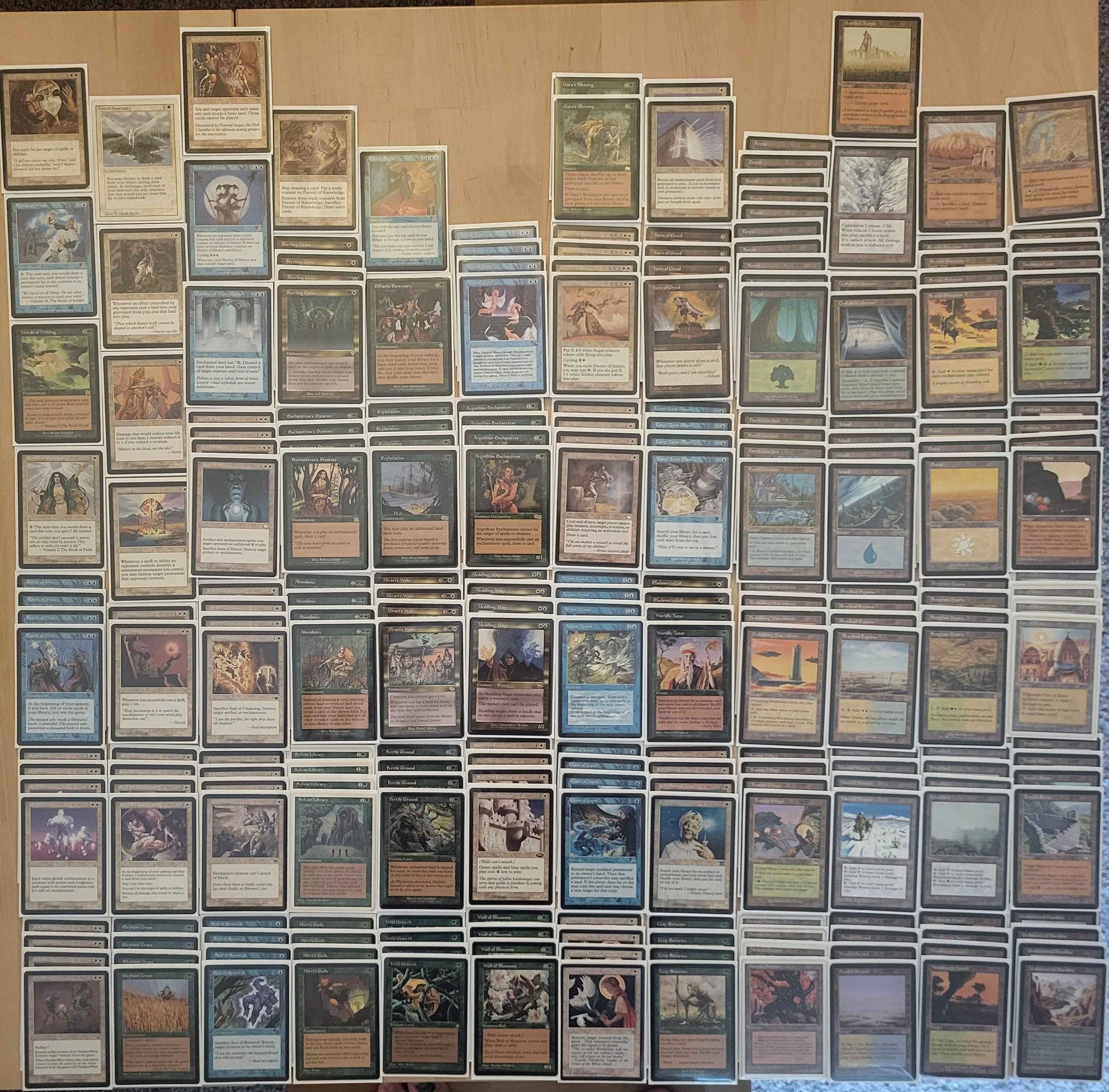
The first prototype of the deck was Enchantress + Replenish + UW Control + all the green engine pieces that weren’t good enough to make the original Enchantress cut. As I refined, I opted to drop a lot of the blue cantrips and dig cards to instead focus on tutors + engines. The idea being that I can rush straight for Battle of Wits in some hands, or use those same tutors to build an unstoppable card advantage engine. With fewer cantrips, I’d have to rely on proper mulliganing and keeping solid starting hands, but I figure I’m playing the mulligan deck anyways. The prototype moved away from Replenish and UW Control, but kept some of the ideas that paired well with the Enchantress focus.
I decided on 240 cards. It left enough space for Battle of Wits to win games, and at the very worst I could build a 60 card singleton deck and then multiply everything by 4 to get my final list. Being quite familiar with 99 card singleton, I figured playing an “oversized” 60 card singleton wouldn’t be too bad when I got to layer with tutors.
For the mana base of the deck I focused on dual or rainbow lands, man lands, and basics. I figured one of the advantages of three colors over five is that my basics were a lot more valuable, and I would give up fewer life points to my own mana base over the course of the game. I took the mythical Frank Karsten 14 color sources and mistakenly multiplied it by 3 instead of 4, and felt foolishly confident with 46 Green sources 42 Blue sources and 52 White sources. While all of my color sources exceeded 42 for 14x3, none of them met 56 for 14x4. While this no doubt caused some extra mulligans across the day, my mana was for the most part acceptable.
The bread and butter of the deck are the engines and the tutors. The engines shouldn’t be too shocking: Argothian Enchantress, Enchantress’ Presence, Mirri’s Guile, Sylvan Library, but also Abundance, Horn of Greed, and a singleton Future Sight. I’ve long loved the Exploration and Horn of Greed engine, and Abundance is another card selection tool that acts as glue for Horn but also the Enchantress pieces. If we can’t run straight to Battle of Wits, we can run to an engine piece and set up a win by virtue of drawing cards.
For tutors: Crop Rotation, Enlightened Tutor, Worldly Tutor, Eladamri’s Call, and Long-Term Plans. We can also throw Sterling Grove in there, although its primary purpose is protecting my value engines. I ran just two copies of Worldly Tutor and Eladamri’s Call due to only owning two copies of each, but this influenced me away from putting in a creature tutorbox to further leverage the value of these cards. For tutors, we can also talk about omissions: notably, no Academy Rector or Intuition. I have no way to reliably graveyard the Rector, and I have little graveyard interaction for Intuition.
The rest of the deck is composed of cards that make mana, cards that win, and cards that interact. There is also a good section of “pillowfort” cards to keep aggro at bay and keep the turns coming. With so many tutors and silver bullets available in the main, I chose not to include a sideboard. I considered a wish-board to use up those 15 slots, but once again found myself dipping too deep into non-enchantment cards. Truth be told, I also didn’t want to fiddle with any more cards and dreaded the idea of finding and replacing singletons in my 240 card pile.
The final numbers for the deck are 88 lands, 92 enchantments, and 60 for everything else. In a 60 card deck, this would translate to 22 lands, 23 enchantments, and 15 for everything else. Conventional enchantress builds are 21-23 lands and 29-31 enchantments, so while I was a little bit off I felt I was decently close. The additional engines and tutors should help smooth the lower enchantment count when it came time to chain draws.
Round 1: Balancing Tingz
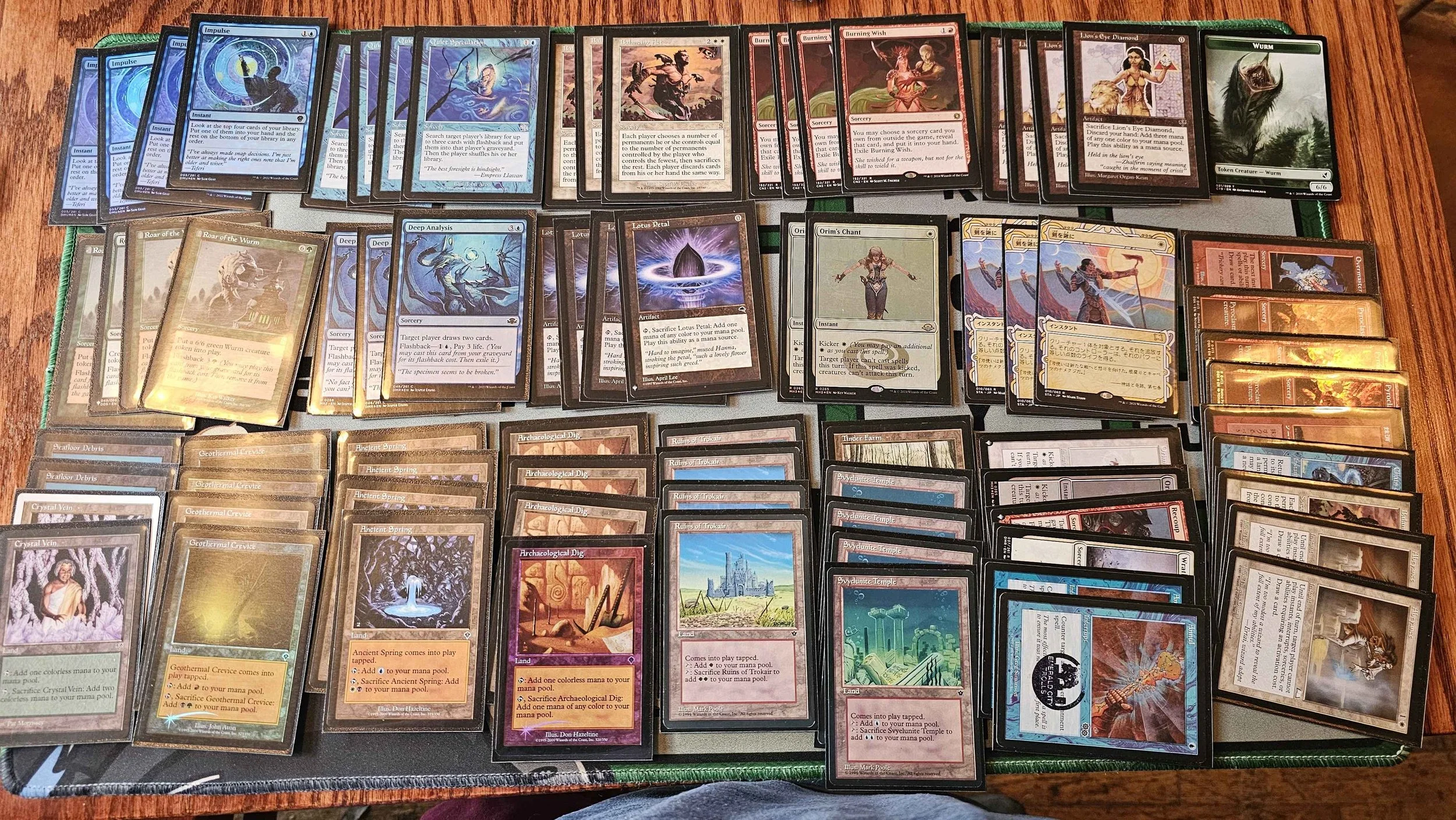
My first round opponent was the inexorable Duck and our match was on camera. Duck is an excellent player, and has a taste for brews and exotic decks. Duck has been a long time collaborator and fellow Enchantress aficionado, and I suspected he wanted payback for my 2-1 win over him in the January monthly. No matter what deck Duck deigned worthy of his time, I knew I’d be in for a tough match.
Game 1 revealed his plan on his first land drop. The sacrifice for 2 mana lands are an instant give away to Balancing Act, and even though this was my first game against the deck I still knew what was coming. I decided to develop my board and dig for answers, playing out a turn 2 Argothian Enchantress. I made a big mistake by forgetting to bounce my Undiscovered Paradise, and then used that mana turn 3 to Gaea’s Blessing a Roar of the Wurm back into Duck’s deck. This proved to be a difficult mistake to unwind, so Duck graciously wanted to play it forward instead of rewind. He then proceeded to play Lion’s Eye Diamond, Lion’s Eye Diamond, Burning Wish, Balancing Act, and Roar of the Wurm. With no cards in play, no cards in hand, and staring down a 6/6 Wurm, I knew why Duck wasn’t worried about the Gaea’s Blessing I shouldn’t have been able to cast.
Game 2 was much better for me. I kept a hand with much more relevant interaction, specifically Meddling Mage, Abeyance, and Arcane Denial. This trio took me most of the way through the game, until a pair of Wurms required a freshly drawn Parallax Wave. I could have gone the distance with my man land + Meddling Mage, but a Battle of Wits gave me the win.
Game 3 was a grindy game, with multiple Swords from Duck on my creatures. After the Balancing Act hit, we were both left with no cards in hand and no cards on board, except Duck was able to use floating mana to flashback Deep Analysis. I drew into a Crop Rotation and Eladamri’s Call, so I’d be able to live through his eventual Roar of the Wurm tokens and rebuild my way to victory. Unfortunately, I drew into Sungrass Prairie, Sungrass Prairie, and Serra Sanctum! I had 3 lands that collectively made 0 mana, and I was unable to get my spells out in time.
Sad to start with a loss for the day, but happy to give a win to Duck. He was a great sportsman about my mistake and played his deck masterfully. This was my favorite match of the day, and I’m glad it was captured on camera, although I could have done without my bozo maneuver being immortalized forever!
Round 2: Classic Madness
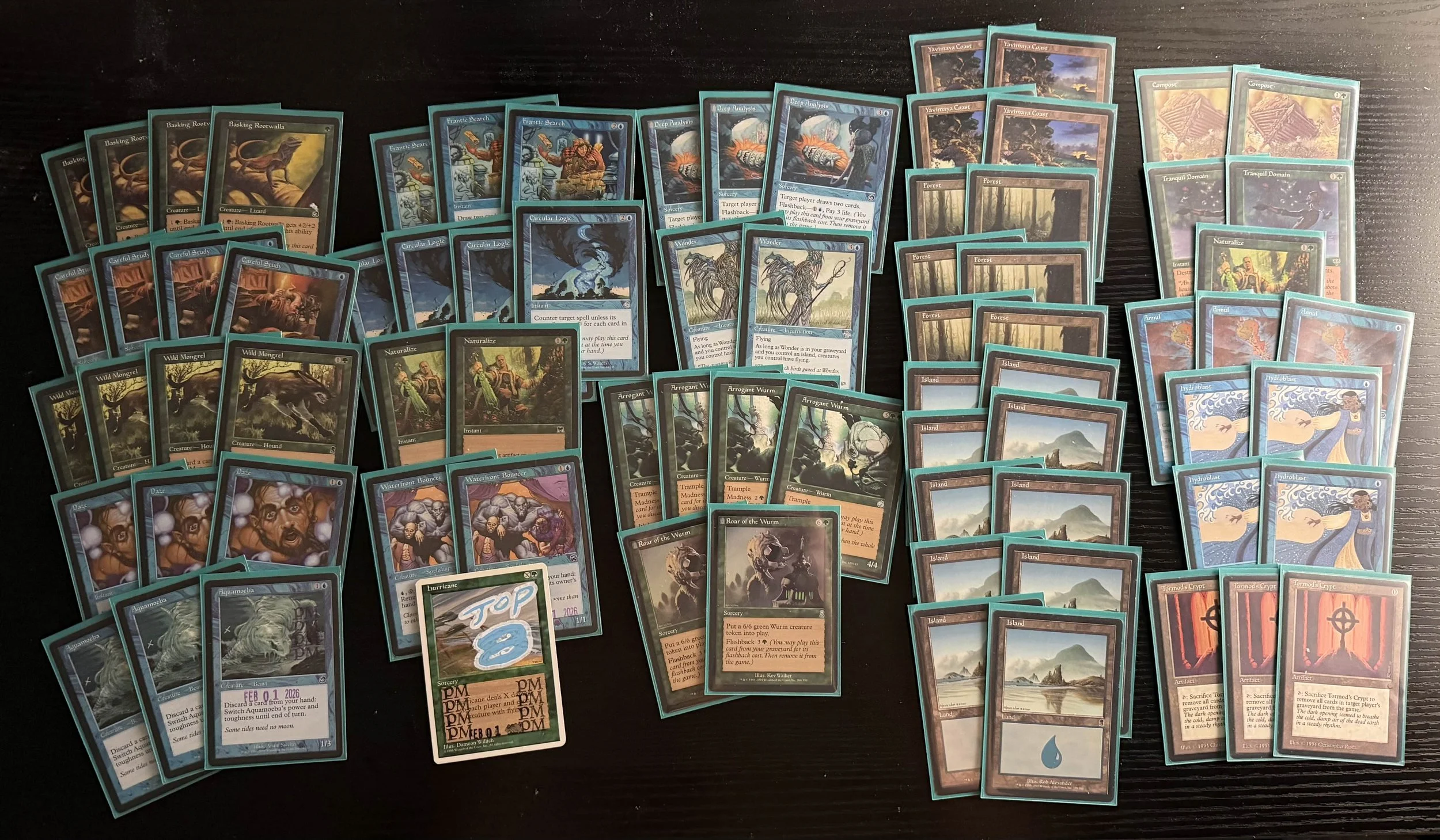
My round two opponent was none other than Johnny. Johnny and I somehow keep pairing up together at events, including matches in the September and October finals, a quarter finals match at a tournament in Albany OR, and most recently during the Swiss of the SCGcon Premodern 1K. Most of these matches have been tilted in my favor due to Enchantress performing quite well against Dreadnought as a deck, but Johnny is a great player and I knew I’d have to bring my best to have a shot at winning this match.
Game 1 was dominated by Kor Haven, repeatedly fogging out Johnny’s early aggression. I used Crop Rotation to pull up Glacial Chasm, which alleviated some pressure and allowed me to spend my mana developing my board. I later found a Deserted Temple, and preventing the attack of two creatures a turn was too much to overcome before the value train left the station. Johnny conceded after my Sterling Grove and Worship landed on the field.
Game 2 was a bit different. I had to keep a Treetop Village and Forbidding Watchtower manned turn after turn to block, eating up my valuable mana. I tried to use Long-Term Plans to set up a Decree of Justice, but I had no additional draw or reach and had to wait the full 3 turns to receive my Decree. A Gemstone Mine expired and my Treetop was traded away, so I was left with not enough mana to meaningfully swing the game with Decree. I cycled it for 3 soldiers thinking it would buy me 3 turns, but I forgot Arrogant Wurm has trample! I was afraid of eating a counterspell but misplayed into the Wurm on the board, oh well.
As we were shuffling for game 3, the round hit time and we decided to take the tie. Maybe the tie saved me from a loss, or maybe that was the win I didn’t have enough time to earn. Either way, Johnny and I added the first tie to our growing history of matches.
Round 3: Tideless Ankh
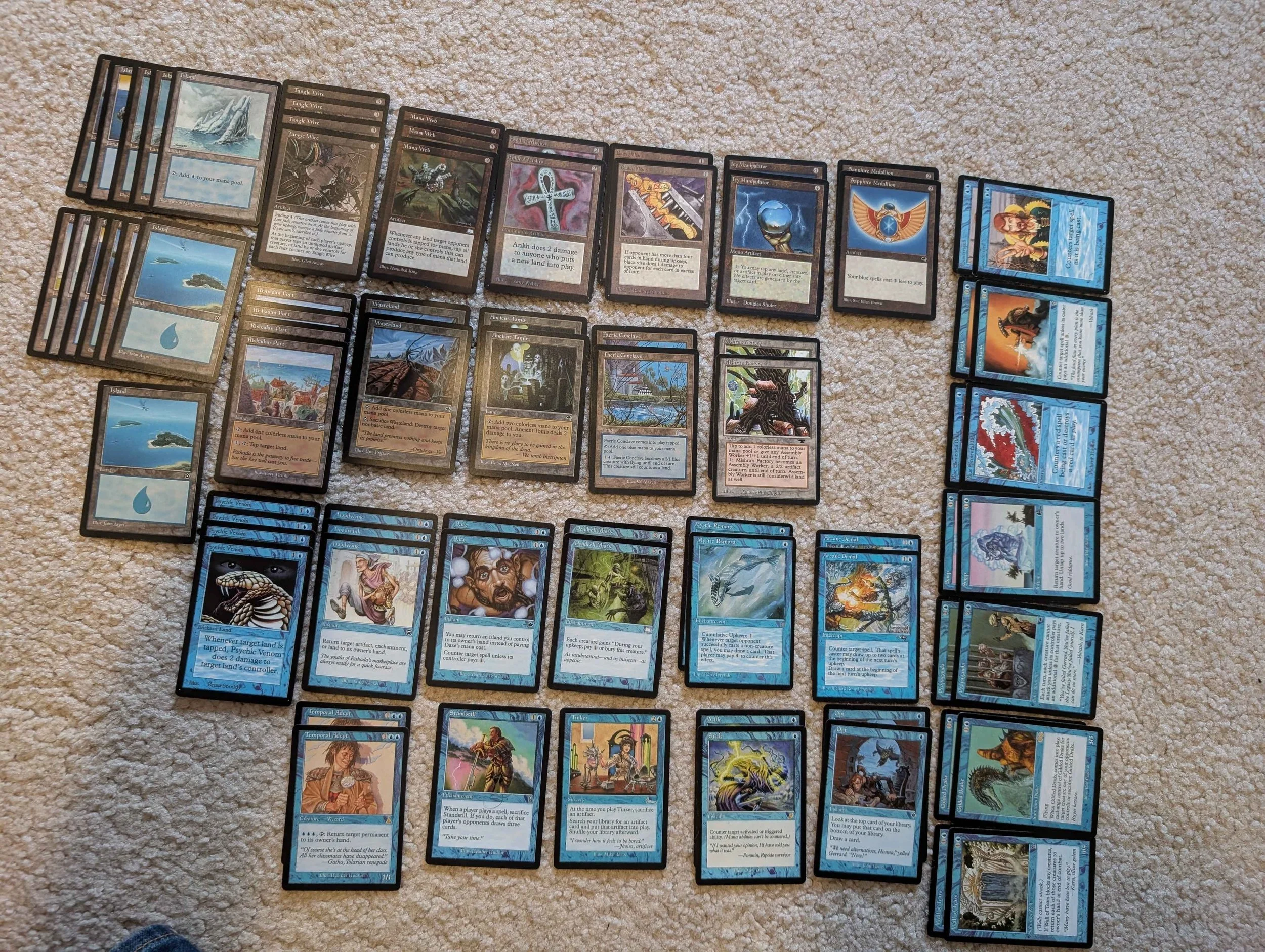
My third round opponent was Joe, a friendly and knowledgeable local known for the high quality proxies he distributes at events. I had played Joe and his new list last month, so I expected to see some blue and some disruptive artifacts like Winter Orb. I asked him what he ended up swapping out for Parallax Tide, and he was kind enough to let me know by dropping Tangle Wire game after game.
Game 1 was a lockdown, with Tangle Wire, Mana Web, and Rishadan Port attacking my mana. After some back and forth, I managed to stick a Battle of Wits and pass the turn. Joe had spent all his bounce and answers attacking my mana, and the unprotected Battle of Wits stole a win for me.
Game 2 I was buried underneath Tangle Wire and three Rishadan Ports. My painful mana base with the addition of a Psychic Venom and Ankh of Mishra chipped away my health until I succumbed. I don’t know what the best draws are for Joe’s deck, but I had to imagine this was pretty close!
Game 3 I was able to play the value grind angle, with an Argothian Enchantress, Horn of Greed and Abundance. My opponent played Sapphire Medallion into three Psychic Venoms, which would have proved fatal in combination with his Rishadan Port. Luckily, a timely Treva’s Ruins bounced the triple Venomed land back to my hand, undoing Joe’s vicious clock and bringing me back into the game. From there, a Mirari’s Wake tipped the scales in my favor, and let me really pump the value train engine. I cycled a Decree of Justice on my upkeep with a Rishadan Port tap on the stack, thoroughly impressed with my own X = 12 until Joe pulled out a Stifle! Unfortunately for Joe, I had plenty of angles of attack and used a Meddling Mage and man lands to seal the game.
Round 4: Wildfire
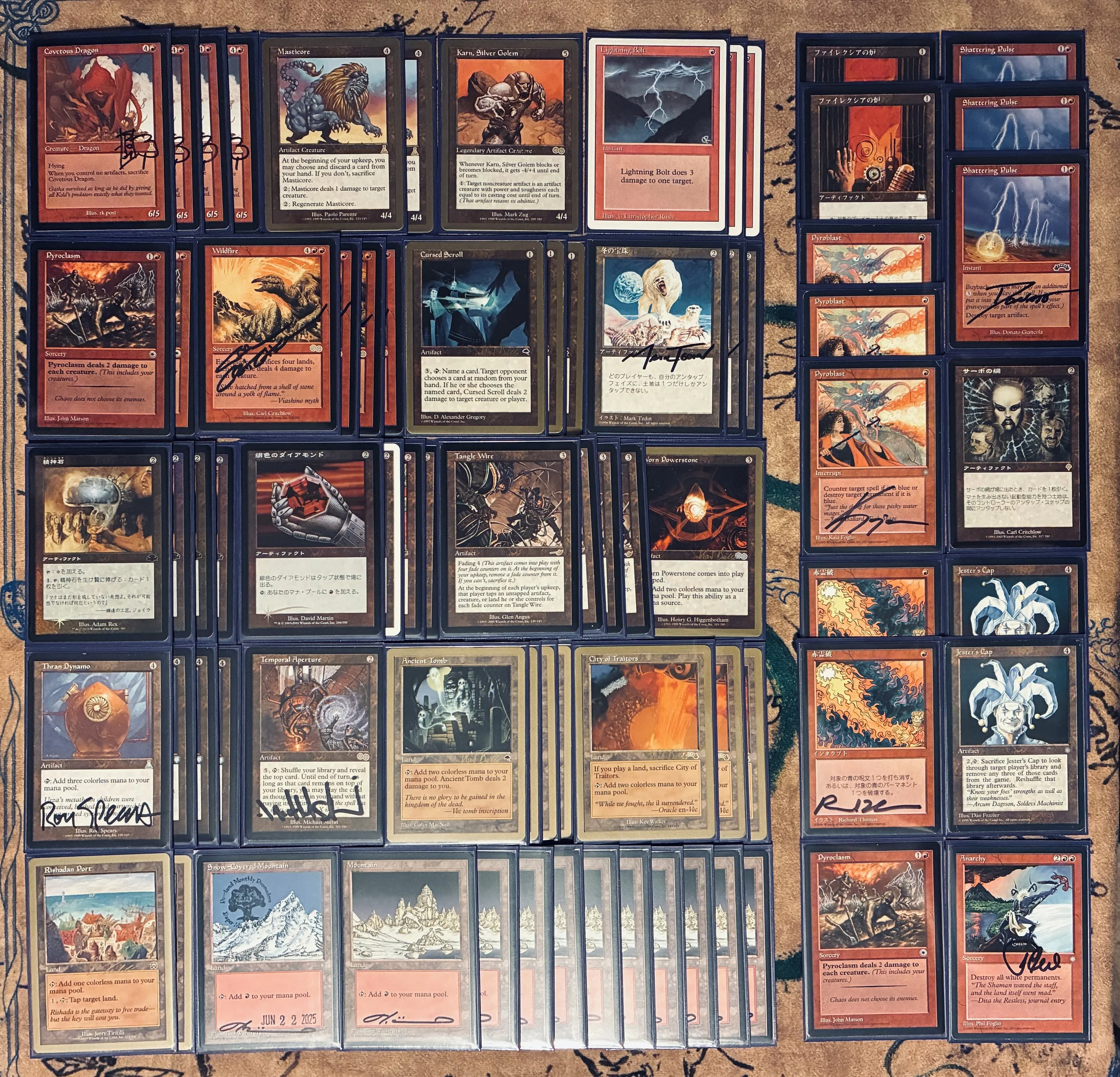
I had the pleasure of Mr. Heavy Play himself as my round 4 opponent. Andrew is a pillar of the Portland scene, and works tirelessly to bring our matches to the world on his Youtube channel. Aside from capturing my victories and losses, Andrew is an impressive collector and has some of the coolest foils and signatures in the Portland crew. Andrew is a known ace on black decks, and recently made the top cut of the SCGcon Portland 1K on Moneyball. I suspected I might be facing some black pile, but Andrew chose to honor the late great Kai Budde by playing the Wildfires deck. With Grim Monolith sitting on the ban list, Andrew was forced to make a swap to . . . Tangle Wire. Another mana denial deck with another swapped in Tangle Wire, just my luck.
Game 1 was brought to a halt after Andrew said “We need to sloooooooow this game down.” A Winter Orb followed by Tangle Wire froze out the game for both sides, and we drew cards and passed back and forth. A second Tangle Wire came down, and we once again drew cards and passed back and forth. I found a Replenish, and my plan became clear: pitch my expensive enchantments during my clean up step to hand size, then find 4 mana to jam a Replenish. I savvily dumped Mirari’s Wake, Mirari’s Wake, Parallax Wave, and Abundance, but with 7 lands on the field constrained by a Winter Orb and Tangle Wire, I was having a hard time building up to 4 for Replenish. A well timed Wildfire nuked my lands, and I began the slow process of building back up. After reaching 3 lands again, I needed just a single land off the top with my Mirri’s Guile to complete the Replenish plan! No luck, and another Wildfire sent me back to the Stone Age. An uncontested Covetous Dragon finished me off. I might have stood a chance in this game if Tangle Wire had been a Grim Monolith.
Game 2, I was mentally prepared for Wildfires and knew I needed to find my singleton Sacred Ground or Elfhame Sanctuary. Andrew played out mana rock after mana rock, and was able to cast Wildfire quite early in the game. I responded with Enlightened Tutor, but Sacred Ground would be too late to make a difference. I tutored Elfhame Sanctuary, and drew a couple lands off the top to cast it. I had a couple Seal of Removals and an Island Sanctuary, so I figured I had some time to sculpt my hand and recover into the game. Andrew is an Old School regular, and knew he had to bait my interaction on his Masticore before playing out his flying Covetous Dragon that could go over the top of my Island Sanctuary. Between land tutors from Elfhame and the lands I drew without it, I didn’t find any new tools to solve problems and still had my 2 Seals and 1 Swords. Masticore took my bounce twice, and then Andrew played out a Covetous Dragon. I knew at this point I needed to handle his 4 Dragons and I could sit behind my Island Sanctuary, so I quickly shot my Swords at it. A second Covetous Dragon landed on the board the following turn, and I had no answers left.
Andrew brought great honor to the Wildfires deck. If anyone reading this is looking for a fun deck that has game against Enchantress, I can recommend this 75 as back breaking for the Enchantress player. Mr. Heavy Play would use this same list to obliterate local Enchantress legend Chris “TenArms” on camera the next round.
Round 5: Oath Ponza
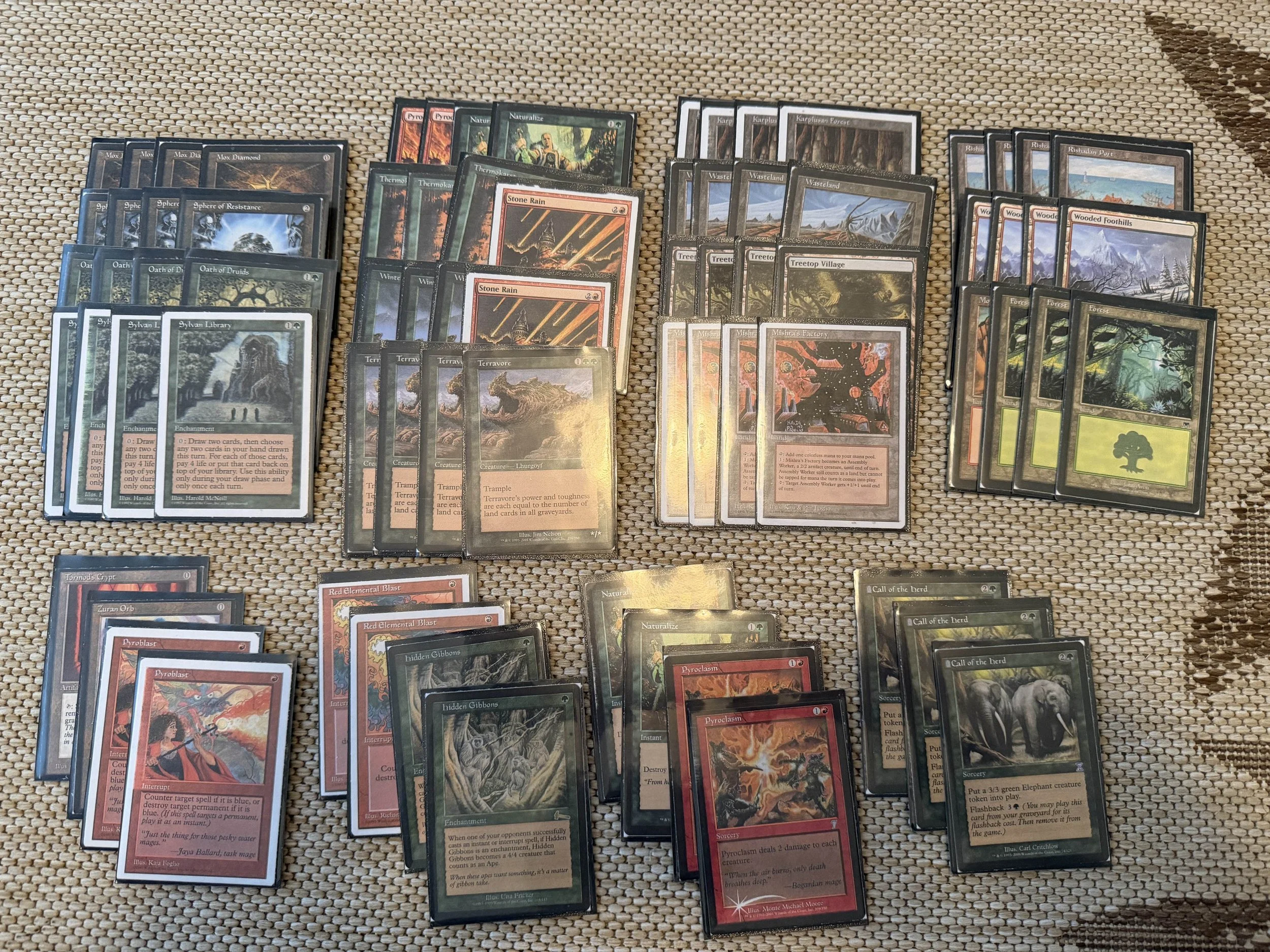
My final opponent for the day was Hari, a gentleman newer to the Premodern scene but well versed in Magic. Hari is a skilled player and gave me a loss in January while piloting Goblins. I had talked with Hari between rounds and I knew he was trying out Terravore. Mana denial had proven to be a thorn in my side this tournament, and I was facing down another mana denial deck.
Game 1 had some back and forth with man lands and elephant tokens, but ended when I cast a Battle of Wits. Throughout this event I won far more games than I had any right to by just casting Battle of Wits without protection and passing the turn.
Game 2 was a nonstop rollercoaster and my favorite game of the day. I had a hand with Exploration, Enlightened Tutor, Elfhame Sanctuary, and some lands, and I knew what I had to do. I bee-lined for Battle of Wits with a turn 1 Exploration, and turn 3 put Battle of Wits onto the stack. Hari was ready for me this time, and sent my Battle of Wits to the gallows with a Red Elemental Blast. I found and used a Sterling Grove to rearm another Battle of Wits attempt, but this was met with a second Red Elemental Blast. I began to assemble some engine pieces as my next plan while Hari built a board with man lands, Terravore, and Oath of Druids. I foolishly accepted an Oath trigger, filling my graveyard up with a ton of lands but giving me an inconsequential Meddling Mage. I named Ray of Revelation, as an efficiently costed 2-for-1 would tear apart the Abundance + Exploration + Horn of Greed engine I had invested all my mana into. A bounce and Arcane Denial on the Terravore bought me another turn cycle, and I continued to dig for cards. Meddling Mage traded with a man land and I finally had some space to breathe with no fear of a Terravore. Without thinking, I cast an Opalescence to build my board and put a clock on Hari, but I forgot this turned back on his Oath! I sent the Elfhame Sanctuary at him, but he decided against trading 2/2’s. His turn came, and Oath flipped up another massive Terravore. A Naturalize removed my Opalescence, and suddenly my situation was looking quite dire. My draws weren’t useful on the board, except for the humble Crop Rotation, which pulled up a perfectly timed Glacial Chasm to save my life! Hari had a Winter’s Grasp ready, and immediately nuked my Glacial Chasm in his second main. To make matters worse, Hari placed a second Terravore onto the table. He passed it back, and I took an Oath trigger (Terravore was already quite lethal) and flipped up a Wall of Blossoms. I used the Wall of Blossoms draw, my regular draw step, and two Horn of Greed draw triggers to Abundance 4 cards, and revealed back to back Swords to Plowshares in my 240 card deck. I made a copy of Terravore with a Dance of Many, fired two Swords at Hari’s two Terravores, and passed the turn. One more draw, and Hari conceded.
Hari had every right to win game 2, but a perfect sequence of cards tipped the scales in my favor. Hari had plenty of answers while still presenting threats. He stopped two Battle of Wits, one lockout from Glacial Chasm, blew up my Opalescence while I had a tutor in hand to find Parallax Wave, and attacked with lethal damage multiple times. Kudos to Hari for his pristine play and resource usage, I’m sure he’ll tear up the March monthly
Post Analysis
I finished the day with a hearty 2-2-1, landing firmly in the middle of the pack at 16 of 30 players. I enjoyed my time on the deck and played some of the most dramatic and memorable matches I’ve ever had in Premodern.
Elephant Grass, Seal of Removal, and Sunscape Familiar were not as useful as I had hoped, but I didn’t encounter the aggro matches where they would shine. Chamber of Manipulation was a stinker, and I realized only after casting it during a game that I’d never be able to successfully attack my opponent with a Terravore or Angel or Shrimp, as the Chamber doesn’t untap or give haste. 2 Gaea’s Blessing were my substitutes for my 2 missing Replenish, and I figured at worst it was a cantrip but at best it could hate on a Quiet Speculation or recycle some key pieces for me. Long-Term Plans was exceptional alongside Mirri’s Guile and Sylvan Library, but clunky in multiples and turned off other shuffle effects while waiting to draw the tutored card.
My choice of 2 Worldly Tutor and 2 Eladarmi’s Call was once again limited by my collection. The cards were great for kick-starting the Enchantress plan, but I would go up to 4 copies and include some singleton toolbox and game winning creatures, such as Nantuko Vigilante, Exalted Angel, Terravore, and maybe even something like Man-o-War.
I was thoroughly impressed by Arcane Denial every time I drew it, but I never used the pro gamer play of countering my own spell to “cycle” it and draw 3. The deck has a lot of instant speed action with the tutors and removal, so including another 4 counterspells could be a solid move. I don’t love Mana Leak timing out as games go long, and Annul is fantastic but misses a lot of key spells like Armageddon and Cataclysm that are fatal to Enchantress. I would also consider Memory Lapse and Counterspell for being able to counter every card type with no conditions, but Memory Lapse is temporary and Counterspell is heavy on color requirements. Instant speed plays and countering key cards was a fantastic angle that Enchantress 240 brought to some games.
I have been a proponent of Exploration in Enchantress ever since I got my 4 copies, and I’m always shocked when people try to cut down to 2 or 3. I feel no differently about Enchantress 240, where Exploration was a great card every time I drew it. To that end, I would add Mox Diamond as another way to speed up the game plan and use those extra lands in hand. I rarely felt like I was stuck without a way to grind value, and Mox Diamond both fixes the mana colors and accelerates to value town faster. Adding a layer of resiliency against mana denial is another bonus, and would have been a blessing in my Wildfires match. Burgeoning is a worthwhile choice and somewhat of a discount Exploration, and I would try to find space for a playset moving forward.
I debated with myself extensively about the inclusion of Fact or Fiction in the list. I loved the instant speed draw, and loved that it worked independently of a value engine. The card is splashable at just U, and affordable at 4 to cast. I think there is a strong case to be made for its inclusion and I wouldn’t fault anyone for trying. In a similar line of thinking, my prototype build included Frantic Search as a card filterer that sometimes made bonus mana with Wild Growth, Fertile Ground, or Serra Sanctum. My fear with these cards is reducing the enchantment count too low, but these cards find enchantments and set up cool graveyard plays with Replenish.
I wish I had thought to include Standstill in Enchantress 240. With 16 man lands and 4 Decree of Justice, we have a lot of ways to play underneath a Standstill, and we can always use the time to play lands and sculpt our hand. Standstill is an enchantment and an independently powerful draw piece with just a single U pip. I would consider changing more slots to support Standstill, such as including more lands with activated abilities or going up on cycling.
The mana base could use improvement. With 12 tap lands, I wanted to avoid Grand Coliseum, Elfhame Palace and Coastal Tower to not clog up early mana production. I think I’d add Grand Coliseum just for being a rainbow land, and I’d add Reflecting Pool as another rainbow. Thawing Glaciers is appealing as a mana fixer and one card engine, but quite slow. The man lands were key players throughout the day, and bought space against attackers while also bringing chip damage. The inclusion of Standstill would be another point in favor of the 16 man lands.
My choice not to include a sideboard only hurt me, but I don’t have any regrets after the event not to include one. 15 cards to fix specific match ups would improve the deck, or it could become a wishboard to allow further tutoring. Living Wish is especially attractive, as it brings an affordable rate and is quite flexible in finding mana producing lands, as well as silver bullet lands or creatures. If I went with a traditional sideboard plan, all 15 slots would go towards anti-combo and anti-aggro tools, especially Cursed Totem and Tormod’s Crypt which function quite well no matter which colors you draw in your opener.
The Future of Enchantress 240
Battle of Wits is a fun thought experiment and a blast to play, but the mechanical effort required in shuffling 240 cards multiple times every game proved tedious. I had a round hit time and was close to time in many of my rounds. While I’d love to play and iterate on the deck some more, the 240 card requirement created numerous holes across the decks in my collection which makes it difficult to keep sleeved.
The matches and games were delightful. Even while chasing consistency with numerous tutors and redundant pieces, I still played numerous cards I’ve never entered into a tournament before. All of my games were unique, and navigating the weirdnesses of each match reminded me of the early years of Commander. While the deck is retired for 2026, the siren song of Enchantress 240 might just pull me back for 2027.
-TQ